
Over the past few weeks, the United States has intervened militarily in Venezuela, removed its sitting president, and announced that it will oversee the country’s future administration and economic direction. The action has been justified publicly using a familiar mix of arguments: alleged election fraud, drug trafficking, terrorism, and national security.
Those claims have been repeated widely, often without scrutiny. They are not new, and they are not unique to Venezuela. Similar language has accompanied US interventions for decades, from Latin America to the Middle East.
This article looks at what sits beneath those justifications. Not the slogans, not the press conferences, but the structural drivers: the dollar system, control of energy pricing, and the seizure of strategic assets. Once those are examined, the intervention in Venezuela becomes far easier to understand, and far harder to defend.
Let’s stop pretending this was anything other than what it was: state terrorism by the United States.
The United States did not “capture” Venezuela’s president; he was kidnapped. That is the correct word, and anything else is public relations language designed to sanitise an act that would be called criminal if carried out by any other country.
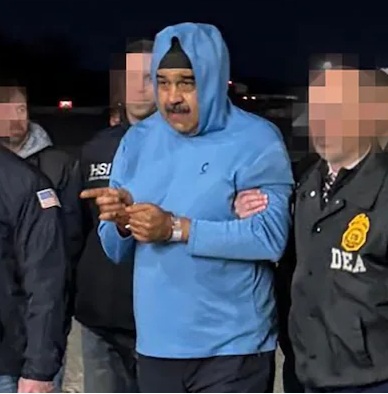
The excuses rolled out afterwards were familiar. Drugs. Terrorism. Democracy. National security. We have heard them all before. None were proven, none justified what happened, and none explain the timing or the scale of the operation.
This was about money, oil and gold.
Venezuela and the petrodollar problem
Since 1974, US power has rested on a single enforced rule: oil must be traded in US dollars. That rule created artificial global demand for dollars and allowed the US to print money while exporting inflation to everyone else. It is the foundation of American financial dominance and deficit spending.
That system only survives if major energy producers remain compliant.
Venezuela did not.
Venezuela sits on roughly 303 billion barrels of oil reserves, the largest on Earth. More than Saudi Arabia. It did not merely criticise the dollar system, it actively stepped outside it. It’s called de-dollarisation. Oil sales in yuan. Direct payment channels with China. Moves towards BRICS. Alignment with China, Russia and Iran. Enough oil to underpin de-dollarisation for decades.
That combination made Venezuela a target.
This is not a theory. There is a clear historical pattern that no amount of media spin can hide.
Venezuela: Resource removal, not regime change
When the US invades or topples a country, it does not simply remove leadership; it removes value.
Iraq’s oil was repriced in dollars and handed to Western firms. Libya’s gold vanished after NATO intervention. Syrian oil has been openly siphoned off under US military protection. This is not disputed. It has been admitted on record.
Venezuela fits the same pattern.
Venezuela’s gold did not end up in Western vaults by accident. A substantial portion has been held in the UK for years, beyond Venezuela’s control, and access was blocked once the country fell out of political favour. Following the kidnapping of its president, there have been reports of US military transport aircraft flying into the UK, including flights going dark over the Atlantic, allegedly connected to the securing or removal of Venezuelan gold.
Oil is taken. Gold is frozen, seized or quietly transferred. Sanctions are used as cover for theft.
This is enforcement, not law.
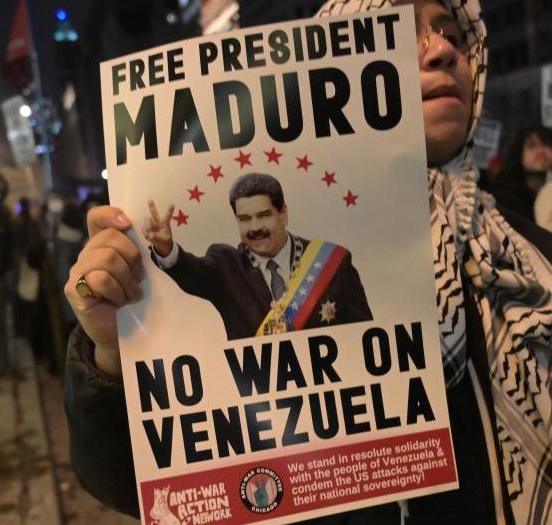
The Chevron, Exxon and Conoco myth
Supporters of the intervention often claim this is about unpaid debts to US energy companies. That argument does not stand up.
Venezuela nationalised oil assets decades ago. Compensation disputes went through international arbitration. Some awards were paid. Some were settled. Some were partially recovered through asset seizures and offsets. Others were later complicated by US sanctions themselves.
This is a civil dispute history, not a national security threat.
Arbitration exists precisely so that states do not resolve investment disputes with force. None of these cases justify invasion, kidnapping a head of state, or seizing sovereign assets.
Venezuela: Drugs, terrorism and democracy
The drug argument collapses almost immediately. Venezuela accounts for a negligible share of US cocaine supply. That has been known for years. If drug trafficking were genuinely grounds for invasion and kidnapping, US foreign policy would look very different.
The terrorism claim fares no better. No evidence has been produced showing Venezuela directing or coordinating attacks against the United States.
Democracy does not survive even cursory scrutiny. The US openly supports absolute monarchies and dictatorships when they comply economically. Elections have never been the standard. Compliance has.
We are told Maduro is “unelected” and that the election was rigged, yet the man the West claimed was the legitimate winner, Juan Guaidó, was never installed. Instead, Trump has said the US will run the country. That alone exposes the claim as procedural cover rather than principle.
Selective justice in plain sight
The double standard becomes impossible to ignore when compared with Honduras.
In late 2025, Juan Orlando Hernández, the former president of Honduras, was freed from a US prison after a presidential pardon, despite having been convicted in a US court of large-scale drug trafficking. Over forty years wiped away with a signature.
So the same US government that claims it must invade Venezuela and kidnap its president over drugs is perfectly willing to release a convicted drug-trafficking head of state when it suits political interests.
That is not law enforcement or justice. It is selective punishment.
The language fraud
This is where the hypocrisy becomes explicit.
For years, Western governments and media mocked Russia for calling its actions in Ukraine a “Special Military Operation”. We were told the wording itself demonstrated bad faith and that refusing to say “invasion” proved dishonesty. Western media then repeated “full-scale invasion” in unison.
Now, Donald Trump announces the Venezuela attack as an “extraordinary military operation”.
The euphemism is the same. The avoidance is the same. The intent is the same. Yet the outrage about language disappears overnight. The press repeats it without challenge, and the standard quietly changes.
If “special military operation” is propaganda when Russia uses it, then “extraordinary military operation” is propaganda when the US uses it. You cannot mock one and normalise the other without admitting the rules are political rather than principled.
The dollar consequence
This matters beyond Venezuela.
The petrodollar is already weakening. Russia trades energy outside it. Iran ignores it. Saudi Arabia is hedging. China has built alternatives to SWIFT. BRICS is expanding settlement systems that bypass the dollar entirely.
Venezuela stepping fully into that system with the world’s largest oil reserves was a threat the US could not tolerate.
So they did not negotiate. They did not prove a case. They sent planes, took oil, seized gold and kidnapped a president.
That is not strength, it is panic.
It will not collapse the dollar overnight, but it does weaken it over time. When a currency has to be enforced with sanctions, seizures and military force, countries hedge away from it, not towards it.
Empires do not fall because enemies attack them. They fall because their rules are exposed as selective.
Renaming crimes does not stop them from being crimes.
And when financiers like Nat Rothschild are already celebrating on Twitter while asset managers circle before the dust has even settled, it tells you exactly who this was for.
Not democracy. Not security. Not the Venezuelan people.
Money, oil and gold.
Debate the author on X here. You can also comment below.